Showing posts with label Romain Meffre. Show all posts

Monday, February 14, 2011

012: Ruin Porn


Yesterday's post acts a precursor to an article recently posted in Guernica by John Patrick Leary of the University of Detroit Mercy, Detroitism. The full article can be found here, but a poignant excerpt follows:


 "Ruin photography, in particular, has been criticized for its “pornographic” sensationalism, and my bookseller friend won’t sell much of it for that reason. And others roll their eyes at all the positive attention heaped on the young, mostly white “creatives,” which glosses over the city’s deep structural problems and the diversity of ideas to help fix them. So much ruin photography and ruin film aestheticizes poverty without inquiring of its origins, dramatizes spaces but never seeks out the people that inhabit and transform them, and romanticizes isolated acts of resistance without acknowledging the massive political and social forces aligned against the real transformation, and not just stubborn survival, of the city. And to see oneself portrayed in this way, as a curiosity to be lamented or studied, is jarring for any Detroiter, who is of course also an American, with all the sense of self-confidence and native-born privilege that we’re taught to associate with the United States."

011: The Ruins of Detroit-pLog

Re-posted from DenverPost.com

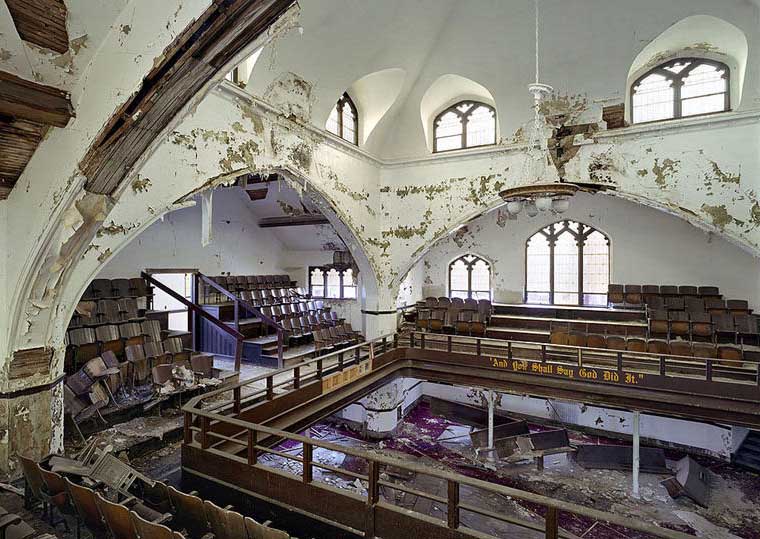
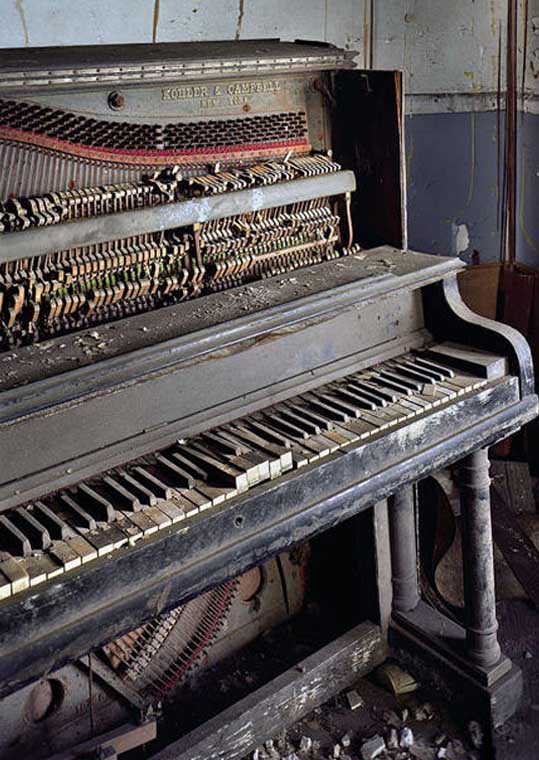
Up and down Detroit’s streets, buildings stand abandoned and in ruin. French photographers Yves Marchand and Romain Meffre set out to document the decline of an American city. Their book The Ruins of Detroit“, a document of decaying buildings frozen in time, was published in December 2010.

From the photographers’ website:
Ruins are the visible symbols and landmarks of our societies and their changes, small pieces of history in suspension.
The state of ruin is essentially a temporary situation that happens at some point, the volatile result of change of era and the fall of empires. This fragility, the time elapsed but even so running fast, lead us to watch them one very last time : being dismayed, or admire, making us wondering about the permanence of things.
Photography appeared to us as a modest way to keep a little bit of this ephemeral state.